Tanto monta, monta tanto.
As much as the one is worth, so much is the other.
In the 15th century, Castile and Aragon were
sovereign kingdoms on the Iberian Peninsula, today’s Spain and Portugal. In
1469, the King Regnant of Aragon, Ferdinand, married the Queen Regnant of
Castile, Isabella.
They were co-monarchs, each a ruler in their own right,
bringing the two monarchies together in a joint venture.
In Castile, Ferdinand had
the title of King, but the legal authority belonged to Isabella. If they
disagreed on a Castilian law, her word was final. In Aragon, Isabella had
immense influence, but the legal and administrative machinery of the Aragonese
territories belonged to Ferdinand.
When they married, their sovereignty was not
merged. It was a personal union and the only thing shared were the monarchs. Each
kingdom had its own separate parliament, laws and tax system. A Castilian
citizen was considered a foreigner in Aragon and vice versa. Your legal rights didn’t
follow you.
They had a Motto. Tanto monta, monta tanto.
As much as the one is worth, so much is the other. It signified they were
equals. The motto was represented by a yoke and arrows representing Isabella
and Ferdinand, respectively. These symbols were tied together by a Gordian knot,
symbolising that the union couldn’t be untied, only cut.
What looked like a marriage soon became a constitutional
argument. Who was primary? Who was junior? Whose court would dominate? Whose
seal would authorise? The union survived not because love conquered politics,
but because power was carefully choreographed.
The famous motto was as elegant
as it was deceptive. Its genius was that it allowed Ferdinand and Isabella to
act as a unified front in foreign policy, while keeping their internal domestic
machines completely separate.
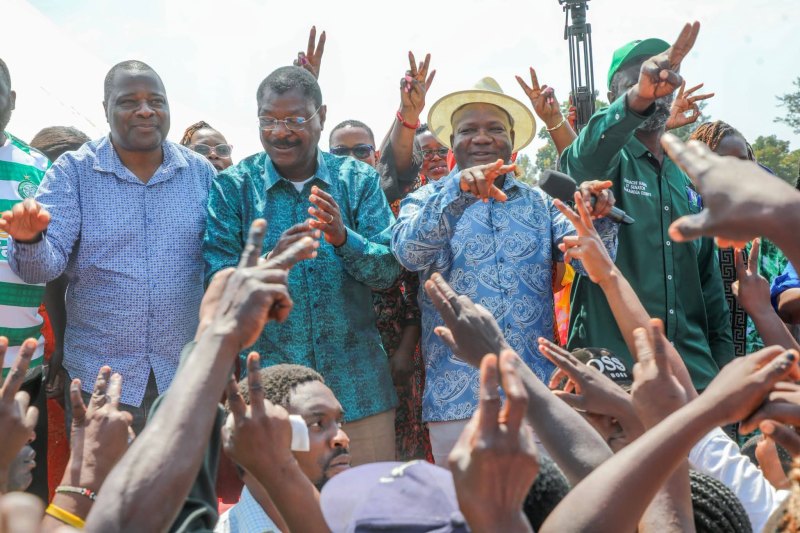
Last week we witnessed our own rendition of tanto
monta, monta tanto.
The Homa Bay Governor and ODM national chairperson, Gladys Wanga, stated the terms of her party's negotiation
engagement with the Kenya Kwanza government.
She said it must do so as a
50/50 equal partner whereby ODM would have the Deputy President position if KK got
the prresidency. And with the confidence of someone announcing a settled matter,
she gestured toward Mining Cabinet Secretary Hassan Joho and said he has what
it takes.
From the ensuing commentary, ODM loyalists heard
dignity, UDA loyalists heard blackmail, and the opposition heard pressure. But
all three readings missed the more interesting point.
Wanga’s demand is not really about the deputy
president. It is about valuation. In political economy speak, this is known as anchoring
effect.
Kenyan coalition politics is a market where
parties are constantly trying to convert intangible assets such as ethnic voting
blocs, candidate brands, party machinery, street legitimacy, historical
grievance and the ability to depress or mobilise turnout in strategic counties
into tangible offices.
These offices include cabinet slots, committee chairs,
principal secretaries, parastatal boards, budgetary access and the presidency.
The real work of coalition politics is not unity. It is pricing.
What Wanga announced was ODM’s opening
valuation. It is a high opening bid designed to shift the eventual settlement
northwards from wherever KK’s private offer currently sits. Wanga is not
expecting 50/50. She is establishing that 50/50 is the floor from where the
negotiations should start.
She was effectively saying that ODM will not
enter negotiations as ornamental legitimacy for another man’s incumbency. It
will enter as a co-owner demanding equity. And in a political economy sense,
that is not irrational.
ODM is not a briefcase party. It has national recognition,
mobilisation depth, and has been one of the few political formations that have survived
even when its presidential candidate loses. It has also, through Raila Odinga,
spent decades acting as both opposition and governing reserve currency. Parties
like that do not believe they should be paid in gratitude. They expect to be
paid in structure.
And that is why the 50/50 language matters.
Not because it is mathematically precise, but
because of what it refuses to be. Coalitions are never really half-and-half.
One side always brings more cash, state power, incumbency, coercive reach or
electoral machinery.
But the equity demand rejects the psychology of junior
partnership before the bargaining has even begun. And this is an important
political function. It tells your base that you are not walking into an arrangement
carrying the furniture while someone else keeps the title deed.
And this is where Wanga’s statement becomes
especially revealing post-Raila. Does ODM become a satellite that rents out
support in exchange for access? Or does it become a structured bargaining
machine capable of converting its remaining political capital into enduring
executive relevance? Wanga’s answer is clear. If there is to be a deal, the
price must signal parity, not absorption.
But there is a complication.
Coalitions are not formed between institutions
of equal discipline, but between political ecosystems with different
incentives. One side controls the state, the other a swing voting bloc. One
side wants loyalty, the other wants guarantees. One side wants absorption
disguised as unity.
The other wants leverage disguised as partnership. This is
why coalition agreements often collapse into resentment. They are written in
the language of mutual respect but executed in the logic of acquisition.
Begs the question. What is ODM selling, and what
is KK buying?
If the 50/50 declaration is a negotiating anchor
rather than a literal parity claim, and if the deputy presidency has been
publicly declared non-negotiable by KK, what is the productive outcome of the
Kilifi statement?
I submit that the answer requires separating the declaration's
three audiences. For ODM's base, it signals that the party is not a supplicant.
This messaging is necessary for a party navigating a difficult post-Raila
legitimacy transition and needs to demonstrate that the broad-based arrangement
is producing returns.
For potential coalition partners and observers, it
signals that ODM is still in the market for the best deal available. For KK, it
is a signal that the current committee arrangement is insufficient and that
something more substantive must be offered before ODM's support is secured. All
three messages are rational. None requires that the demand be literally
achievable.
But if ODM is selling numbers, then the
valuation argument is straightforward. A party that can still shape turnout and
neutralise opposition zones will demand a premium. However, if ODM is selling
legitimacy, then their ultimatum weakens.
Legitimacy is useful, but it is not
sovereign power. It can soften an administration’s image, widen its ethnic
optics, and fracture an opposition coalition, but it does not justify half the
house.
However, there is another layer. The deputy
presidency in Kenya is no longer merely a ceremonial position. It has become highly
priced because of what the office now symbolises after Rigathi’s impeachment and
the broader realignment of Mt Kenya politics.
It is now read as a referendum on
who counts, who is being courted and who is being reassured. To demand it is therefore
symbolic co-ownership of the coalition. That is why Wanga’s statement lands
with such force. It is a declaration that ODM does not intend to be decorative.
Finally, my first unsolicited advice is to
Gladys Wanga. The tanto monta monta tanto motto is yours to deploy. But opening
bids are not closing deals. You have done what serious politicians ought to do
in negotiations.
You have named a price before someone else names it for you.
Whether that price is realistic is a different matter. But now we will stop
pretending that these talks are about unity. They are about valuation.
However, there is a difference between political
valuation and realisability. ODM can declare itself worth 50 per cent. But
coalitions are not priced by self-esteem but by necessity.
The question is
whether KK will need ODM enough by 2027 to pay that kind of premium. If KK can
rebuild its own numbers, fracture rivals and retain enough incumbency
advantage, then ODM’s price may be deemed too high. If, however, KK finds
itself facing a fragmented but dangerous opposition, a restless electorate and
a thinning path to first-round victory, then your price may start to look less
like arrogance and more like the market rate.
Secondly, it is to KK. Do not dismiss Wanga’s statement
as noise. It is early bargaining architecture. She is trying to do two things
at once. First, to harden ODM’s negotiating floor and second, to shape the
imagination of what is politically thinkable.
In coalition politics, this
matters. The side that names the terms early often changes the range of
outcomes later. Today it sounds audacious. Tomorrow it may sound probable. That
is how political pricing works.
Ferdinand and Isabella's union survived 50 years
of joint rule and produced the most powerful empire in the world. It also
produced the Spanish Inquisition, the expulsion of the Jews and the
subjugation of the Americas, none of which appeared in the Concordia de
Segovia's careful provisions.
Coalitions are evaluated by what they build and
what they destroy, not by whether the founding formula was honoured in every
document. History will evaluate ODM and KK’s coalition on the same terms.
Political alliances are often
like marriages; the fine print becomes visible only after the vows – Unknown
The writer is a political economist