Last
week, there was outrage across the country following comments made by UDA secretary
general Hassan Omar, which appeared to profile the Kikuyu community.
In
reality, however, the rising anti-Kikuyu sentiment had been widespread within
regime networks, including their partners in the broad-based faction of ODM.
Omar may have seemed reckless in his comments, but the recklessness had been on
for weeks within the political class.
It
is easy to see the source of desperation within the Ruto regime. Impeached
former DP Rigathi Gachagua has led a vicious political campaign against the President
in his central Kenya backyard, a campaign which has practically eroded Ruto’s
erstwhile support in the region to levels unforeseen.
In response, the head of
state’s associates have responded by painting the Democracy for Citizens Party
leader black, but often not drawing a distinction between the former DP and his
ethnic community.
Until
last week, the ethnic political undertones targeting the Kikuyu community had
come mostly from the ODM faction that supports the government, where its top
officials have loudly cited historical grievances against former Kikuyu regimes
as a basis for whipping up tribal emotions.
Indeed, senior leaders like ODM
leader Oburu Oginga and National Treasury CS John Mbadi have been consistent at
this, going as far as questioning the legitimacy of former President Uhuru Kenyatta’s 2022 desire to have the former Prime Minister Raila Odinga succeed
him.
There
is an electoral permutation to explain this. Having lost the Mt Kenya
community, Ruto needs another huge voting bloc to anchor his reelection bid on.
And the one that is dependent and large enough is the Luo Nyanza base, previously loyal to Raila. But to achieve this, his strategists have to keep
the Luo politically as far away from the Kikuyu as possible.
The methods and
rhetoric may appear unsavoury and divisive, with possible damaging long-term
effects, but Kenya’s political class has never been one to consider long-term consequences of actions.
While
all this has been going on, something else has been happening: the rise of
Nairobi senator and ODM SG Edwin Sifuna as a national sensation in Kenya’s
politics.
It’s an almost hilarious narration, if ever there was one. When the
ODM National Executive Committee met at a coastal resort to remove its SG,
everyone expected it to be a smooth and quick move. Instead, the monumental
fumbles by the party over the process, plus the instant sympathy that Sifuna
generated following the purported removal, changed the trajectory of everything
and caught the broad-based partners flat-footed.
At
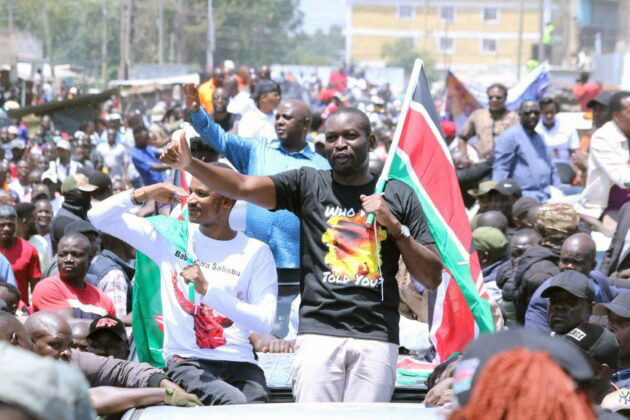
first, it started as an online youth movement rallying around the embattled SG
with their catchy ‘sisi ndio Sifuna’ clarion call. But after the Sifuna-led
Linda Mwananchi movement, born out of the fallout in ODM, made several
well-received tours of several counties, it was obvious that a powerful movement
had been born out of the supposed persecution of the senator.
A recent Tifa
poll indicated that Sifuna and his group had ultimately grabbed more than 70
per cent of the ODM base, and the other faction loyal to Oburu was gasping for
breath, with the worst yet to come for the latter.
Because
of Sifuna’s rise in stature on the national platform, the dynamics have been
changing rapidly in his Western homeland. Indeed, several leaders, including Cooperatives
CS Wycliffe Oparanya and Lurambi MP Titus Khamala, have openly stated that
marketing President Ruto in the neighbourhood has become an uphill task, a fact
attributed to the growing influence of a son of the Mulembe nation as an
emerging presidential candidate and a darling of the masses in the hinterland.
It looks like the dream of politician Musa Amalemba, for a united Luhya
position on the national stage, may finally come to fruition, more than 70
years later.
The
Luhya community is a collection of several sub-tribes, often taking diverse
political routes at election time. The return of multiparty politics in 1992
brought this to the fore in the most glaring way. In that election, the Bukusu
of Bungoma and Trans Nzoia aligned with Jaramogi Oginga Odinga’s Ford Kenya, while the larger Kakamega and Busia cast their lot with President Moi’s Kanu
and Kenneth Matiba’s Ford Asili.
It
is only until 2002, when a national movement disenchanted by the long Kanu rule
and lining up behind Mwai Kibaki for the presidency in that year’s election,
that a large portion of the Mulembe people joined other Kenyans in ushering in
the Narc rule with an overwhelming mandate. But even then, the sub-regional
fault lines were always there, hindering any long-term community homogeneity in
pursuit of political power.
Part
of the reason for this has always been that the community has hardly ever had a
political son or daughter with the requisite national influence to go ahead and
become a unifying personality across the Western region.
Before their deaths in
1992 and 2003, respectively, politicians Masinde Muliro and Wamalwa Kijana
seemed destined for big national roles in the country, which would have placed
them firmly in a position to consolidate the Western bloc and make it a giant
player in Kenyan politics. We will never know what might have been in their
cases.
But
the rapid rise of Sifuna and the support he continues to elicit from other
leaders within the Luhya nation now point to something spectacular emerging.
Indeed, some of the leaders earlier expected to stand in his way, like Trans
Nzoia Governor George Natembeya, have already expressed support for the Nairobi
senator, should he emerge as the light of the community in the 2027 electoral cycle.
In the meantime, there is discernible panic and anxiety among politicians not
aligned to Sifuna in Western, especially the old guards who have spent decades
striking sweet deals at election time.
The
Western region had 2.2 million voters on offer in the 2022 general election. It
is expected to surpass the three million mark in 2027. However, it has never
harnessed this large resource into a powerful single bloc, the way that Luo
Nyanza, Central and Kalenjin Rift Valley do every election time.
Of course,
there have been interests served by the continued division of the Luhya vote
into several disparate political formations, just like a united Luhya front
would pose a challenge to these interests.
It
is actually an interesting fact that the ability of one individual to
effectively unite his community into a single voting bloc relies so much on
that individual’s influence among other tribes.
Tribal numbers are easily
mobilised on the belief that the local kingpin is accepted in other regions,
and therefore stands a real chance to either deliver the ultimate prize of the
presidency or to hit high enough for a consequential compromise.
The youth
renaissance that has propelled Sifuna to the top of Kenyan politics in such a
short time, and made him now a permanent feature in presidential opinion polls
and top contender, has also become the tool through which he may finally become
the first man to unite the Luhya nation in the coming election.
It
is still early days, and no one can yet tell what seat the Nairobi senator will
run for. But as the regime and its surrogates unleash dangerous anti-Kikuyu
political rhetoric, the Luhya are experiencing a positive tribal awakening in
the emergence of their son as a national unifying symbol and therefore, ultimately, the Luhya unity that will be a key cog in his presidential
ambitions.
Amalemba must be smiling in his grave.