The parliamentary contest has attracted national attention, with political observers describing it as one of the costliest constituency elections in recent history.
The poll has also thrust the newly reconstituted IEBC into the spotlight, with its ability to contain voter bribery, violence and other electoral malpractices expected to serve as an early test ahead of the 2027 general election.
Official campaigns ended on Monday at 6pm, exactly 48 hours before polling day, in accordance with the Elections Act.
Nine candidates are seeking to succeed the late Ol Kalou MP David Kiaraho, who died on March 29, 2026, while undergoing treatment at Nairobi Hospital.
Although nine candidates are on the ballot, the race has largely narrowed into a political duel between President William Ruto's United Democratic Alliance (UDA), whose candidate is Samuel Nyagah, and the Democracy for the Citizens Party (DCP), which has fronted Sammy Ngotho.
Speaking on Tuesday, IEBC chairperson Erastus Ethekon said preparations for the by-election were complete, with the training of all election officials concluding on Monday ahead of a final stakeholder engagement involving candidates, security agencies and other election players scheduled for Wednesday.
Voting will take place in 144 polling stations spread across the constituency's five wards.
To protect the credibility of the election, the commission has rolled out a raft of security and electoral protocols that voters, candidates, agents and election officials will be required to observe.
Among the measures is a ban on the wearing of party colours, campaign-branded clothing or any other political paraphernalia inside polling stations.
Voters will also not be allowed to enter polling booths with mobile phones in a move aimed at preventing photographs of marked ballot papers from being taken and circulated on social media.
"The sanctity and the secrecy of the vote requires that you keep it secret. That's why we facilitate you to vote by way of secret ballot. So it will defeat the whole purpose if you make that ballot public," Ethekon said.
He warned that exposing a marked ballot paper is an offence under the Elections Offences Act and attracts severe penalties.
"You will actually be prosecuted and when found guilty, you will pay a fine of up to Sh1 million. The offending party can also be imprisoned for a term not exceeding three years."
The IEBC chairperson said voters will be identified biometrically using the Kenya Integrated Election Management System (KIEMS), with only the original national identity card or a valid Kenyan passport being accepted for identification.
He added that the Register of Voters has already been printed and displayed at every polling station as required by law to enable voters to verify their registration details before polling day.
Assisted voters
Ethekon reaffirmed that voters who require assistance will be free to choose a person they trust to help them cast their ballot.
"So, nobody should force anybody to be assisted. If they wish to be assisted and our officers have verified that the person requires assistance, let that person choose a person of his or her choice to assist," he said.
He, however, stressed that one assistant can only help one voter.
"No one person is allowed to assist more than one voter. We will not see a situation whereby one person is hovering around the polling station purporting to be assisting one voter after another."
Agents and security
Each candidate or political party will be allowed only one accredited agent at every polling station and one chief agent at the constituency tallying centre.
Ethekon said the commission will not recognise so-called "super agents", adding that anyone without official IEBC accreditation will not be allowed to operate within polling stations.
"We have asked the National Police Service to help us deal with any phenomenon of super agents who are mainly some of the senior politicians in this country," he said.
Security officers have also been directed to ensure voters leave polling stations immediately after casting their ballots.
Each presiding officer will be supported by two police officers responsible for maintaining law and order within a 400-metre security perimeter around every polling station.
Anyone who disobeys lawful instructions issued by the presiding officer will be ordered to leave, with further legal action taken where necessary.
"In each of the polling stations, we've put the rules there, so we urge the voters and citizens of Ol Kalou to familiarise themselves with those rules," Ethekon said.
He warned that any attempts by goons to storm polling stations or disrupt the electoral process would be met with an appropriate security response.
The IEBC chairperson added that the Electoral Code of Conduct will remain fully in force throughout polling day, with candidates and political parties found in breach facing disciplinary action.
Voting, counting and declaration of results
Voting will begin at 6am and close at 5pm. However, voters who are in the queue by 5pm will still be allowed to cast their ballots.
Counting will start immediately after the close of voting at each polling station in the presence of agents, accredited observers and the media to enhance transparency.
"To enhance transparency, the agents present will be allowed to take photographs of the official results Form 34A and send them to their candidates or political parties," Ethekon said.
A copy of Form 34A will also be displayed outside every polling station immediately after counting.
Results from all 144 polling stations will then be delivered to the constituency tallying centre, where the Returning Officer will verify, collate and officially declare the winner.
"I know results will be known by the political parties and agents, but please do not declare yourself the winner or your candidate. It's only the authorised officer — the Returning Officer — who will declare the winner in the presence of the agents and accredited observers," Ethekon said.
The constituency results will also be uploaded to the IEBC public results portal in real time, allowing members of the public to follow the tallying process as it unfolds.
With heightened political interest and unprecedented scrutiny surrounding the by-election, Thursday's vote will not only determine Ol Kalou's next MP but will also offer an early indication of the IEBC's readiness to oversee a credible 2027 general election.



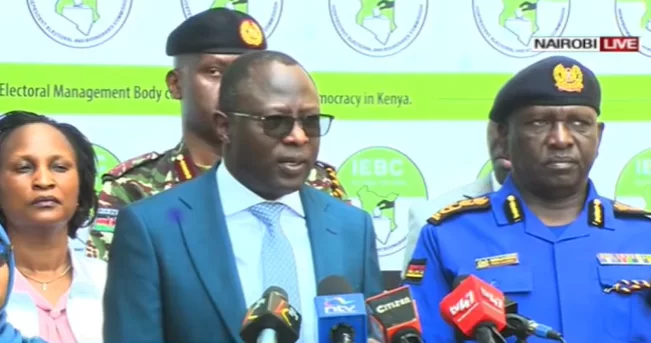 IEBC chairperson Erastus Ethekon addressing the media flanked by security bosses, July 14 /SCREENGRAB