But behind the uniform lay a chilling plan that would end
the lives of his two young children and their mother.
Nearly seven years after the October 2019 killings, justice
yesterday finally caught up with the former military officer as the High Court
in Milimani sentenced him to life imprisonment.
This is after the Director of Public Prosecutions (DPP)
secured his conviction on three counts of murder.
Mugure has said he will appeal his conviction on three
counts of murder but will not challenge the sentence imposed by the High Court.
Addressing the court before sentencing, Mugure said he
respected the court's decision despite disagreeing with its findings and had
instructed his lawyers to challenge only the convictions.
"For the record, my name is Major Mugure of the Kenya
Defence Forces," he told the court.
"Your Lordship, you and I have walked step by step
through this highly charged and emotive public criminal trial, right from PW1
to PW26 up to this very moment in time. I understand and fully appreciate the
weight of expectations placed on the shoulders of Your Lordship in the hearing
and determination of this matter."
"Having delivered a verdict of guilt on all three counts,
I respect the decision of the court, for it presently legally binds me in ways
no one can possibly imagine. Nevertheless, and with tremendous respect to the
court, in principle I am unable to agree with the verdict."
In his decision Justice Martin Muya observed that Mugure had
shown "no iota of remorse" throughout the trial and described the
killings as "barbaric."
The prosecution had urged the court to impose the death
penalty, but he was instead sentenced to life imprisonment on all three counts,
to run concurrently, noting the growing prevalence of infanticide and femicide
and the need for deterrent punishment.
"The accused showed no iota of remorse. These barbaric
acts, amid rising infanticide and femicide, demand severe punishment,"
ruled Justice Martin Muya.
The court heard that Mugure, then stationed at the Laikipia
Air Base, lured his family to the military installation under the guise of an
ordinary family visit on October 25, 2019.
What appeared to be a routine reunion was, in reality, the
final stage of a carefully orchestrated plan.
Prosecution painstakingly reconstructed the events leading
to the murders, presenting compelling evidence that exposed the calculated
nature of the crimes.
Evidence showed that on the morning of October 26, of that
year, Mugure took his two children out, purportedly to show them around the
airbase, before killing them.
Later that evening, he murdered their mother.
Rather than report the deaths, prosecution proved that
Mugure concealed all three bodies in the boot of his vehicle before driving
them away from the airbase and dumping them at a remote location.
Perhaps the most damning evidence came from witnesses who
testified that the former army major had visited the burial site three days
before the killings and arranged for a shallow grave to be dug.
That testimony convinced the court that the murders were not
spontaneous but meticulously planned.

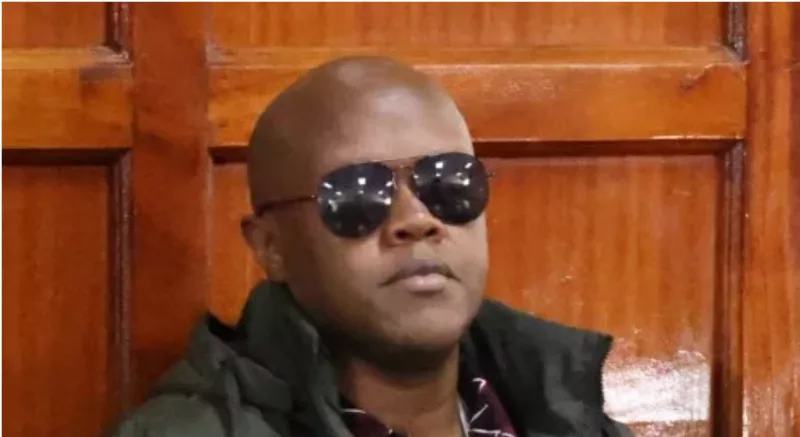
 Former Kenya Defence Forces Major Peter Mugure before Milimani Law Courts on July 14, 2026 /EZEKIEL AMING'A